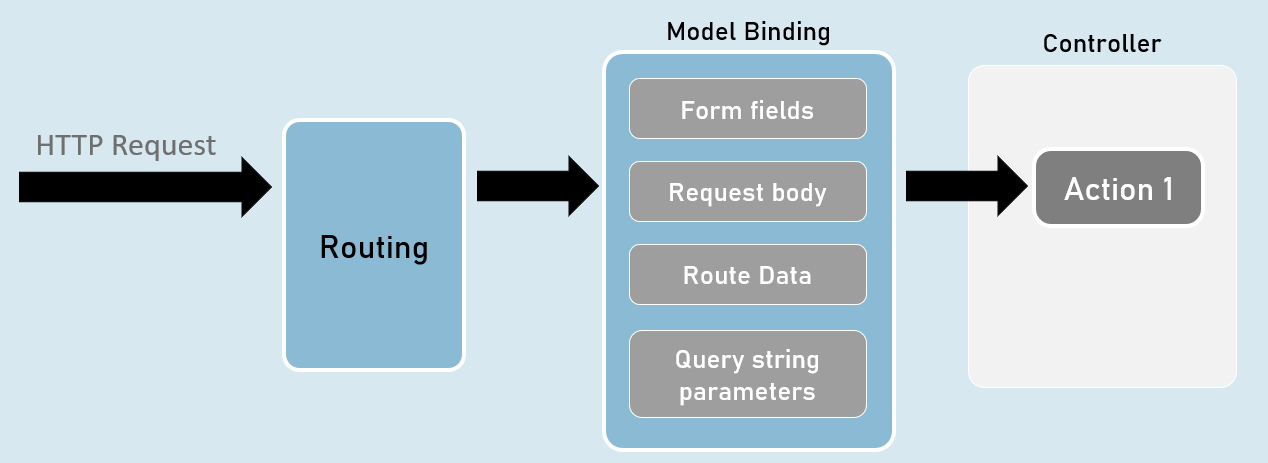
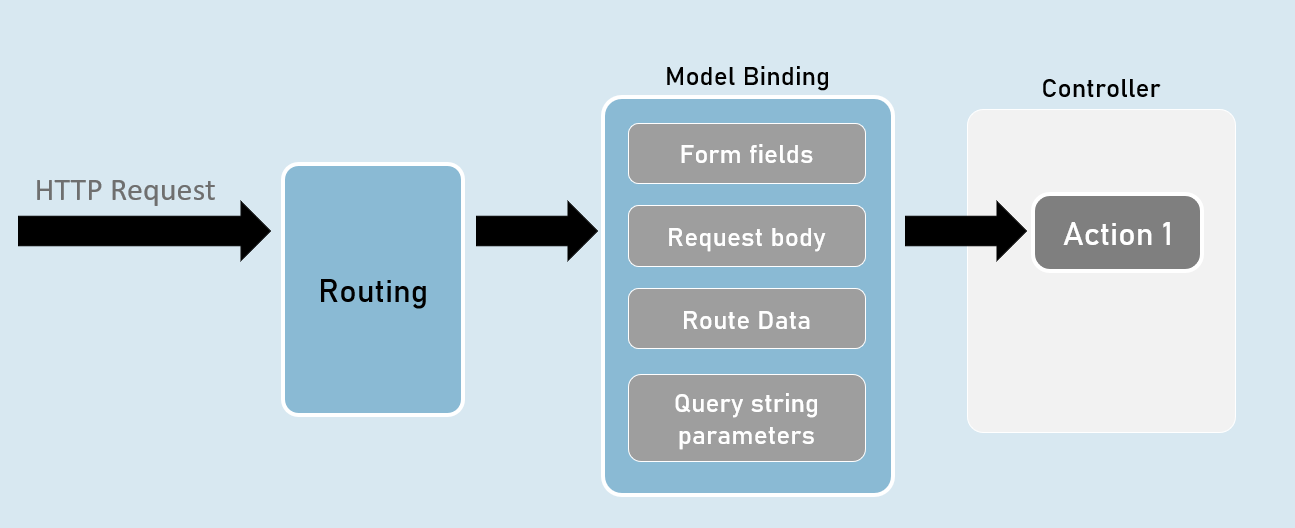
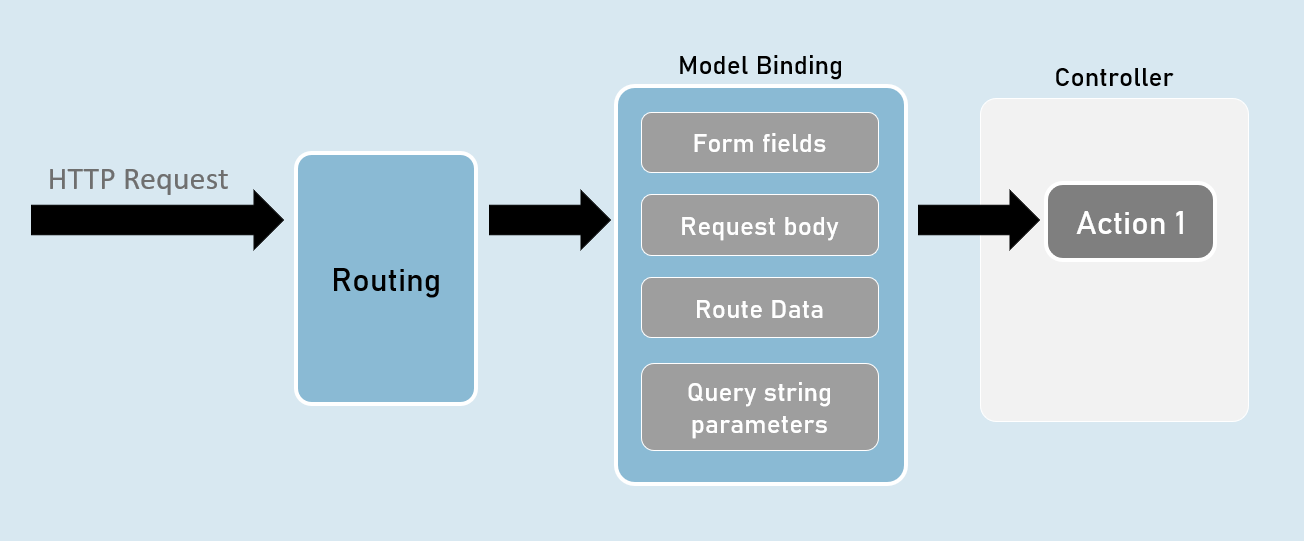
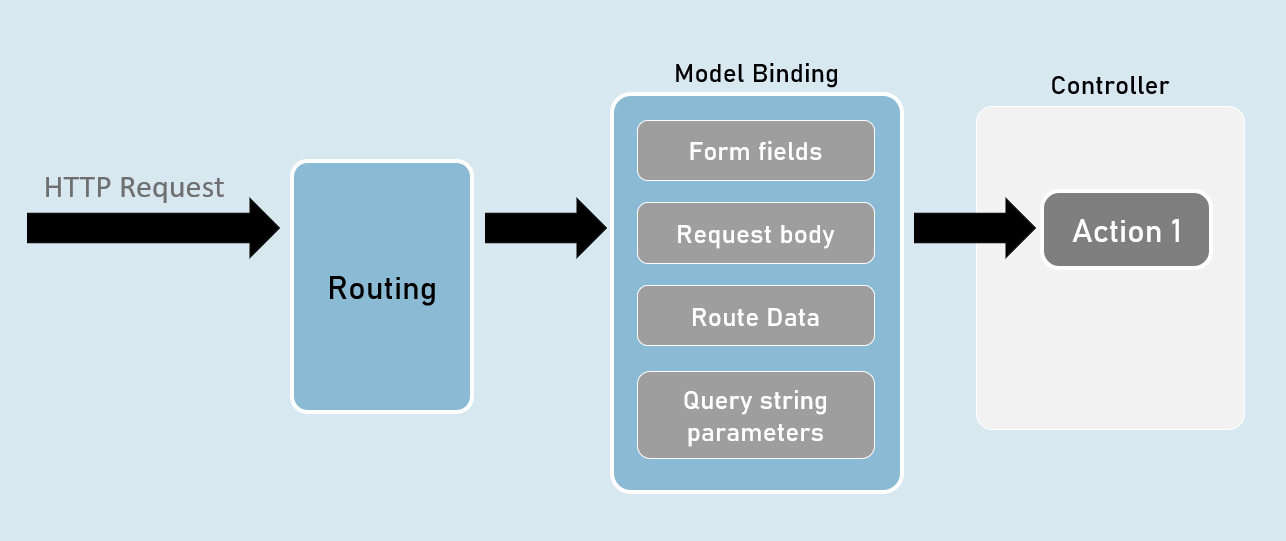
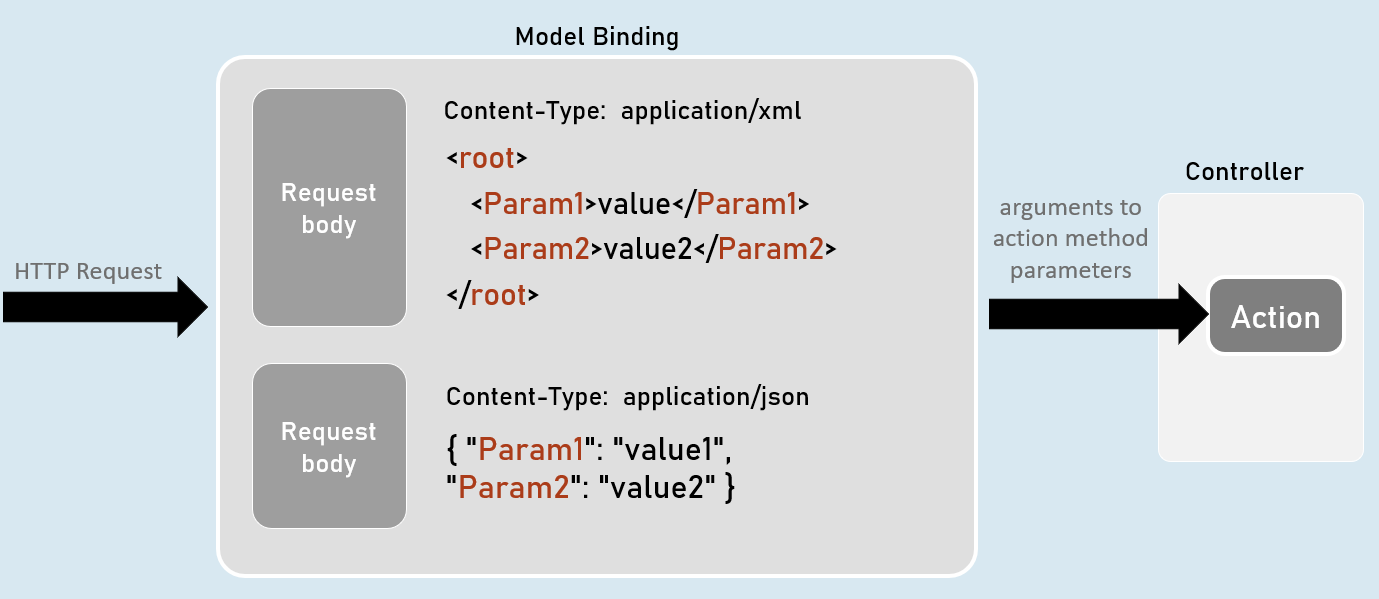
Model Binding is a feature of asp.net core that reads values from http requests and pass them as arguments to the action method.
QueryString vs RouteData
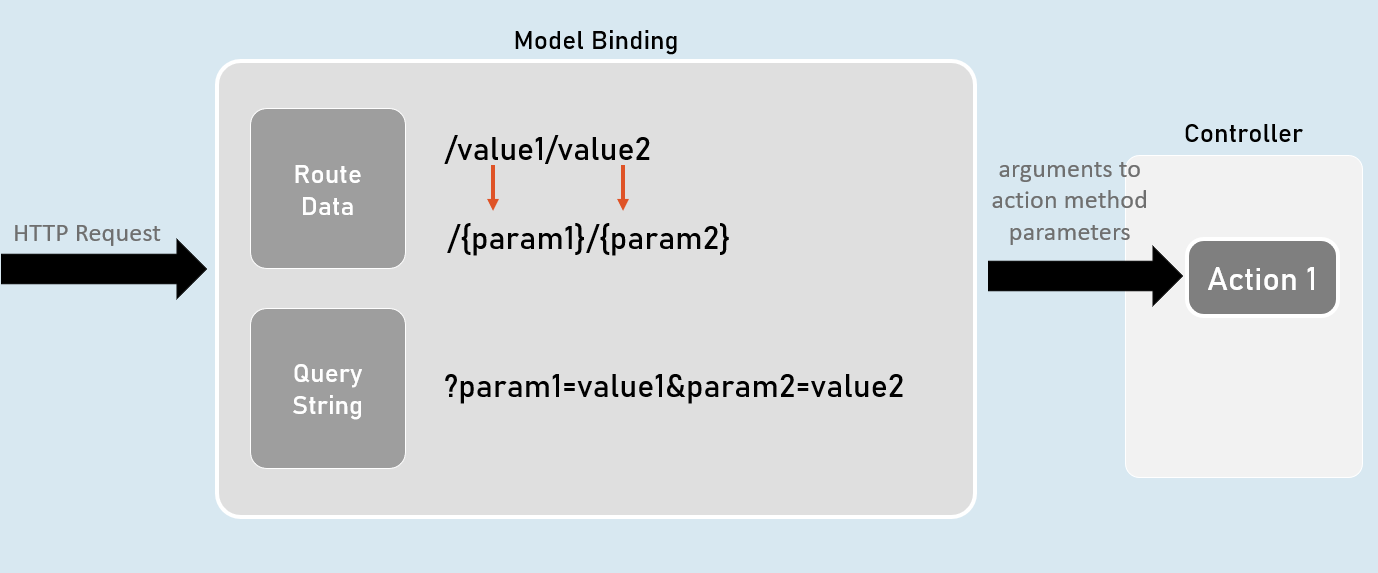
[FromQuery] and [FromRoute]
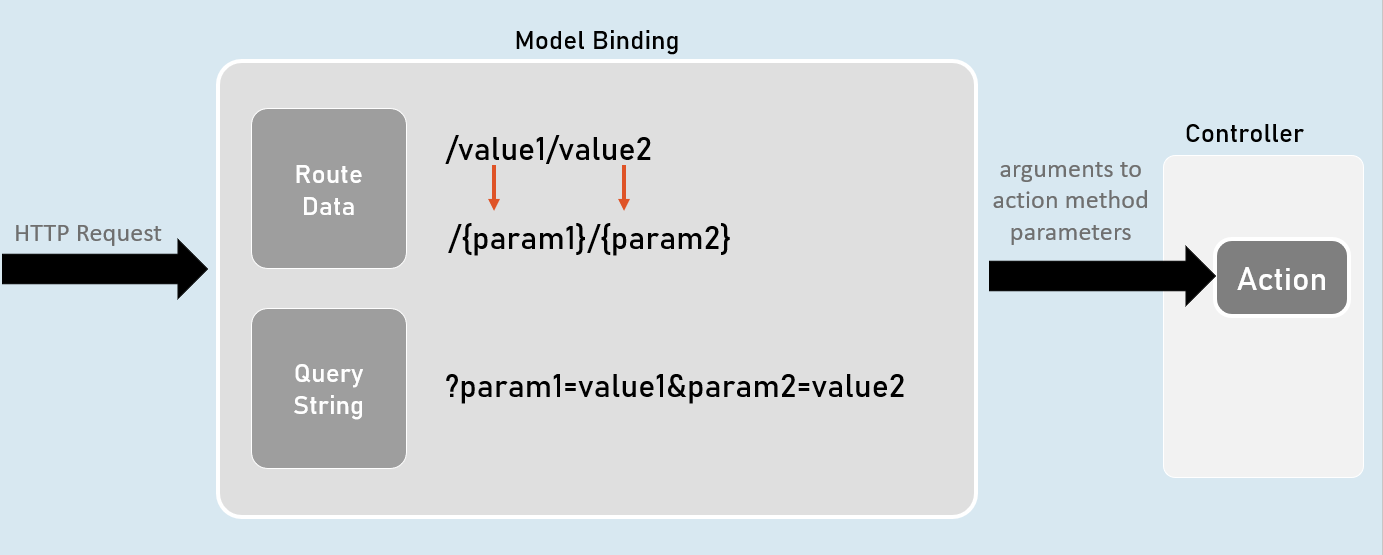
[FromQuery]
[FromRoute]
//gets the value from query string only
public IActionResult ActionMethodName( [FromQuery] type parameter)
{
}
//gets the value from route parameters only
public IActionResult ActionMethodName( [FromRoute] type parameter)
{
}
Models
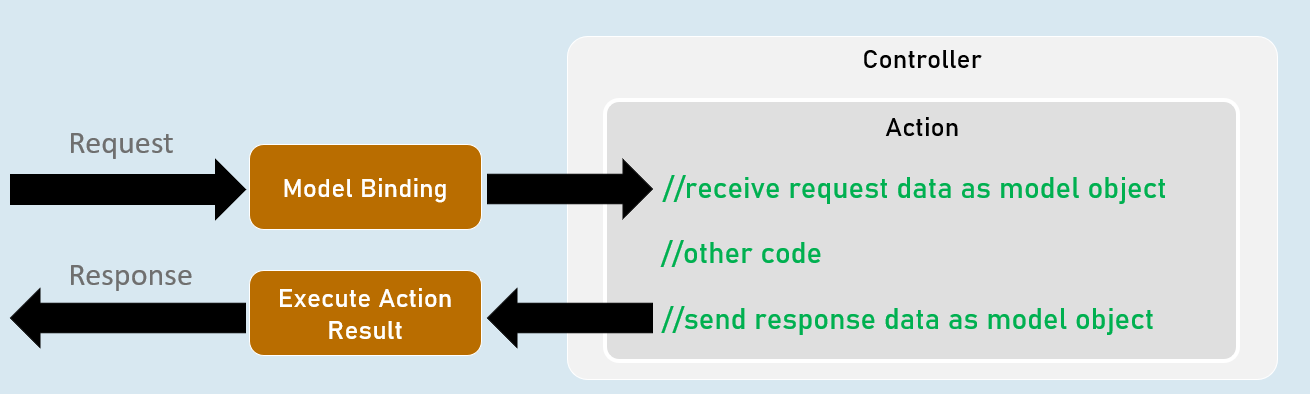
Model is a class that represents structure of data (as properties) that you would like to receive from the request and/or send to the response.
Also known as POCO (Plain Old CLR Objects).
Model
class ClassName
{
public type PropertyName { get; set; }
}
form-urlencoded and form-data
form-urlencoded (default)
Request Headers
Content-Type: application/x-www-form-urlencoded
Request Body
param1=value1¶m2=value2
form-data
Request Headers
Content-Type: multipart/form-data
Request Body
- d74496d66958873e Content-Disposition: form-data; name=“param1”
value1
- d74496d66958873e Content-Disposition: form-data; name=“param2”
value2
Model Validation
[Attribute] //applies validation rule on this property
class ClassName
{
public type PropertyName { get; set; }
}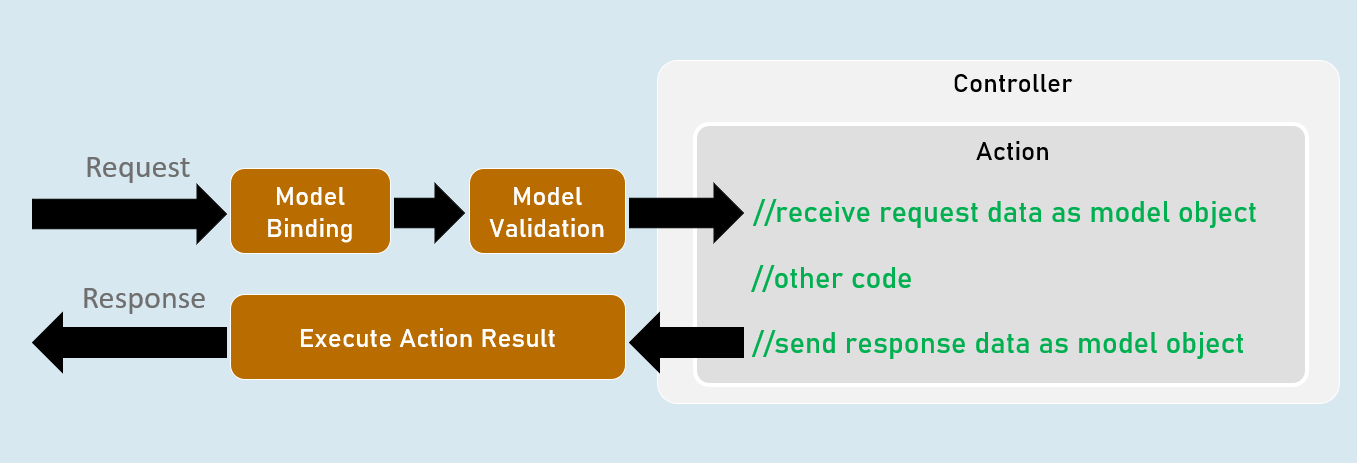
ModelState
IsValid
Specifies whether there is at least one validation error or not (true or false).
Values
Contains each model property value with corresponding “Errors” property that contains list of validation errors of that model property.
ErrorCount
Returns number of errors.
Model Validation
[Required(ErrorMessage = “value”)]
Specifies that the property value is required (can’t be blank or empty).
[StringLength(int maximumLength, MinimumLength = value, ErrorMessage = “value”)]
Specifies minimum and maximum length (number of characters) allowed in the string.
[Range(int minimum, int maximum, ErrorMessage = “value”)]
Specifies minimum and maximum numerical value allowed.
[RegularExpression(string pattern, ErrorMessage = “value”)]
Specifies the valid pattern (regular expression).
[EmailAddress(ErrorMessage = “value”)]
Specifies that the value should be a valid email address.
[Phone(ErrorMessage = “value”)]
Specifies that the value should be a valid phone number).
Eg: (999)-999-9999 or 9876543210
[Compare(string otherProperty, ErrorMessage = “value”)]
Specifies that the values of current property and other property should be same.
[Url(ErrorMessage = “value”)]
Specifies that the value should be a valid url (website address).
[ValidateNever]
Specifies that the property should not be validated (excludes the property from model validation).
Custom Validations
class ClassName : ValidationAttribute
{
public override ValidationResult? IsValid(object? value, ValidationContext validationContext)
{
//return ValidationResult.Success;
//[or] return new ValidationResult("error message");
}
}
ValidationAttribute
- Base class for all validation attributes such as RequiredAttribute, RegularExpressionAttribute, RangeAttribute, StringLengthAttribute, CompareAttribute etc.
• Provides properties such as ErrorMessage & methods such as Validate(), IsValid() etc.ValidationContext
• Acts as a parameter for "IsValid()" method of custom validation attribute classes.- Provides properties such as ObjectType, ObjectInstance.
Custom Validations with Multiple Properties
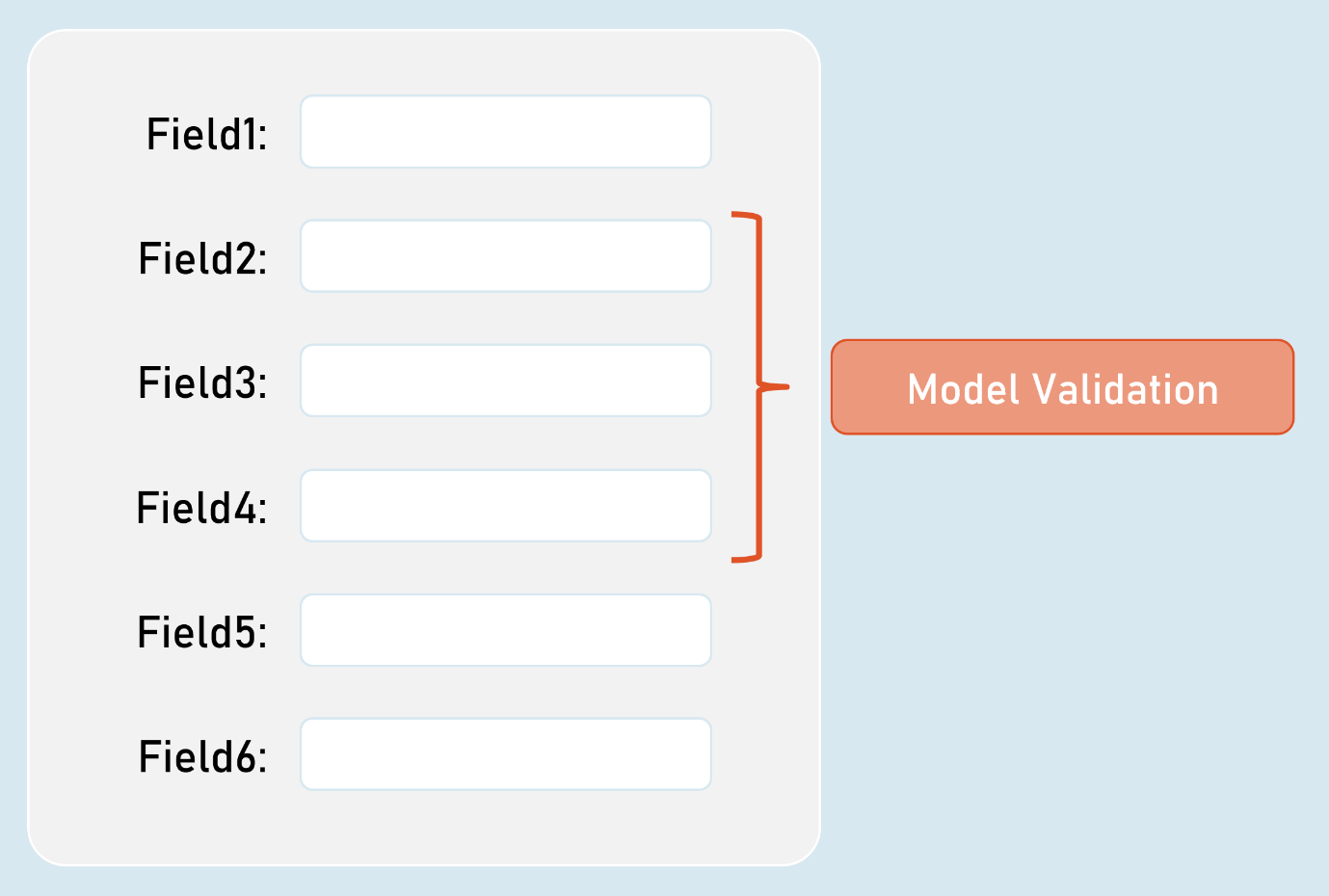
IValidatableObject
yield return new ValidationResult(“error message”);
- Base class for model classes with validation.
class ClassName : IValidatableObject
{
//model properties here
public IEnumerable<ValidationResult> Validate(ValidationContext validationContext)
{
if (condition)
{
}
}
}
• Provides a method called Validate() to define class level validation logic.
• The Validate() method executes after validating all property-level validations are executed; but doesn't execute if at least one property-level validations result error.
ValidationContext
• Acts as a parameter for "Validate()" method of model classes with IValidatableObject.- Provides properties such as ObjectType, ObjectInstance.
[Bind] and [BindNever]
[Bind]
- [Bind] attribute specifies that only the specified properties should be included in model binding.
class ClassNameController
{
public IActionResult ActionMethodName( [Bind(nameof(ClassName.PropertyName), nameof(ClassName.PropertyName) )]  ClassName parameterName)
{
}
}
• Prevents over-posting (post values into unexpected properties) especially in 'Create' scenarios.
[BindNever]
[BindNever]
- [BindNever] attribute specifies that the specified property should NOT be included in model binding.
- Useful when you have fewer properties to eliminate from model binding.
class ModelClassName
{
public type PropertyName { get; set; }
}
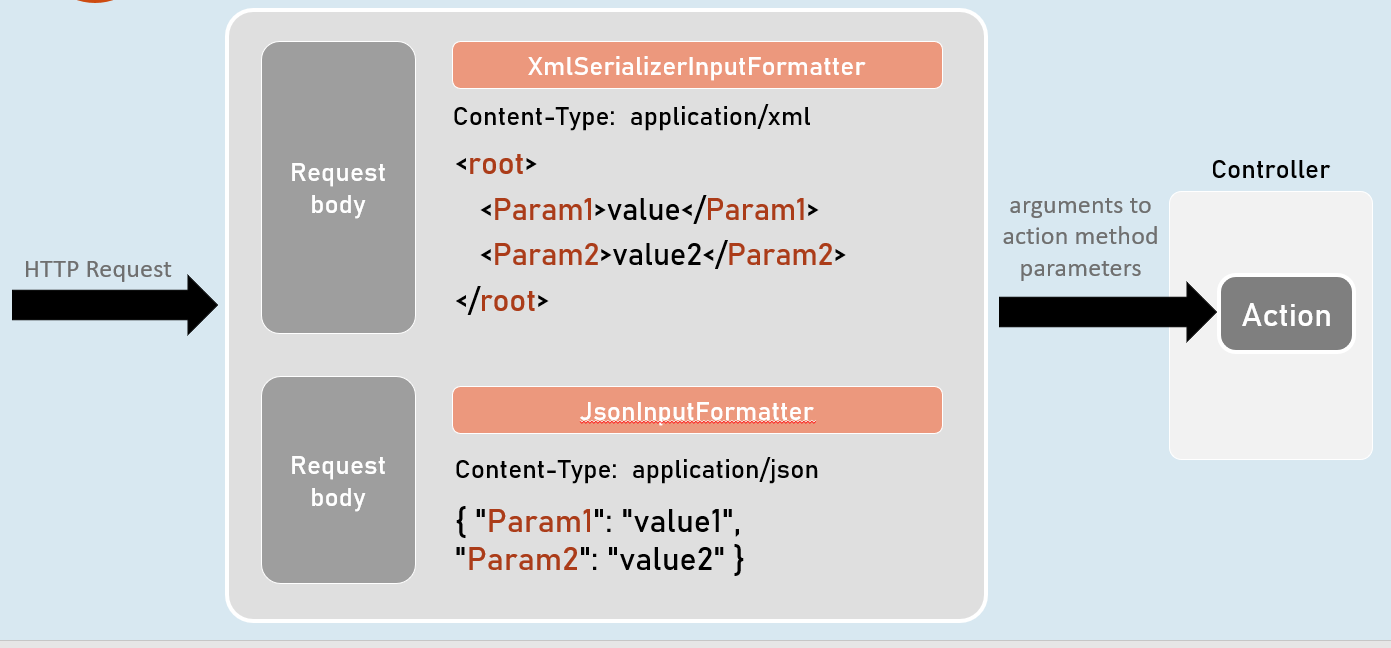
[FromBody]
//enables the input formatters to read data from request body (as JSON or XML or custom) only
public IActionResult ActionMethodName( [FromBody] type parameter)
{
}
Input Formatters
Custom Model Binders
Custom Model Binder
class ClassName : IModelBinder
{
public Task BindModelAsync(ModelBindingContext bindingContext)
{
//gets value from request
bindingContext.ValueProvider.GetValue("FirstName");
//returns model object after reading data from the request
bindingContext.Result = ModelBindingResult.Success(your_object);
}
}
IModelBinder
- Base interface for all custom model binders.
• Provides a method called BindModelAsync, to define logic for binding (reading) data from the request and creating a model object that has be received as parameter in the action method.ModelBindingContext
• Acts as a parameter for "BindModelAsync()" method of custom model binder classes.- Provides properties such as HttpContext, ModelState, ValueProvider, Result etc..
Custom Model Binder Providers
class ClassName : IModelBinderProvider
{
public IModelBinder GetBinder(ModelBinderProviderContext providerContext)
{
//returns type of custom model binder class to be invoked
return new BinderTypeModelBinder(typeof(YourModelBinderClassName));
}
}
IModelBinderProvider
- Base interface for all custom model binder providers.
- Provides a method called GetBinder, to return the type of custom model binder class.
ModelBinderProviderContext
• Acts as a parameter for "GetBinder()" method of custom model binder provider classes.- Provides properties such as BindingInfo, Services etc.